
Reading games
Two RTP figures need a version check before a comparison
A version-aware RTP worksheet and a transparent 96% versus 94% example distinguish game specifications from session results without inventing casino data.

What we checked 5 cited sources · facts checked 19 September 2026 · method · source list
A slot title is not a complete specification
Two percentages beside the same slot title need investigation before they become a finding about two casinos. Establish whether both figures describe the game's theoretical return, the same version and the same scope of play. A session's observed return and a game's published design figure are different quantities, even when both are called RTP.
The Gambling Commission's testing procedure asks for more than a game's name: test reports include its RTP, software number, digital signature and the channels covered. Those fields show why the title alone is an incomplete technical identifier. They do not prove which version any particular casino currently serves.
This article supplies a comparison method and an original arithmetic example. It does not publish an RTP league table or claim to have opened games at two operators. Bet365's public help directs readers to the in-game menu for RTP information; that is an operator's documented route, not an observation of a logged-in game. A named, current comparison needs evidence from the actual game instances being compared.
Sources: Testing strategy: Procedure for testing; What is RTP and Volatility?.
Separate a design percentage from a measured result
The Commission calculates actual RTP by dividing the wins returned by a game's turnover. Its example compares that observed result with the theoretical figure and explains that volatility and the amount of play affect the interpretation of a difference. A lower observed result is not, by itself, evidence that the configured theoretical return was lower.
Our comparison sheet therefore begins with a quantity field. Write theoretical RTP from the rules, actual RTP for a stated dataset, or unknown. Do not move to a numerical ranking while that field is blank. A percentage in a forum post may describe a person's returns; another percentage on a provider page may describe a game design. Subtracting them does not repair the mismatch.
Next record the period and denominator for any measured figure. Deposits, total stakes and money left in an account are not interchangeable. A report that gives only starting and ending balances does not necessarily reveal turnover, particularly when money is staked repeatedly. This is why the worksheet asks for the underlying definition before asking whether the number looks favourable.
Sources: How to calculate return to player (RTP).
A worked comparison using invented specifications
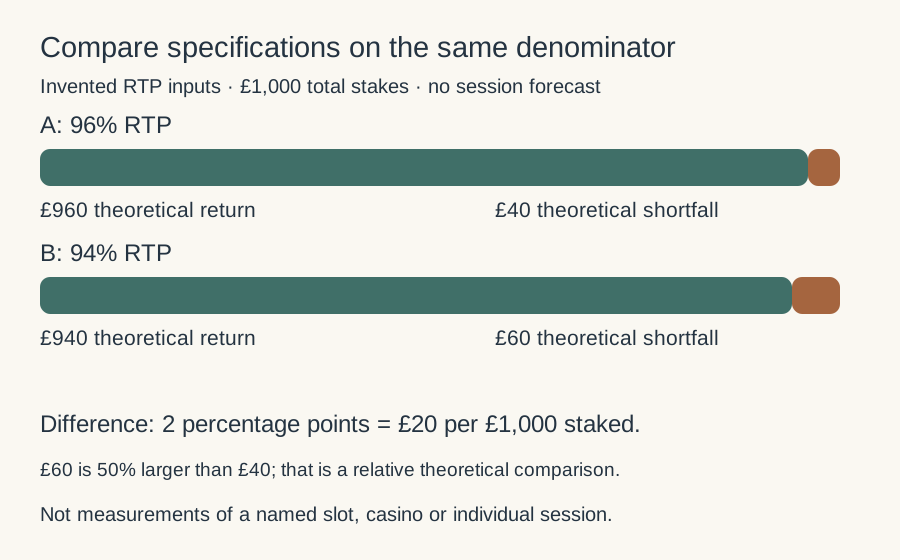
Suppose specification A states a theoretical RTP of 96% and specification B states 94%. These are invented figures for a calculation; no named slot or casino is being assigned either setting. Use £1,000 of total stakes as a common denominator, not a proposed deposit or a suggested amount of play.
The theoretical return associated with A is £1,000 multiplied by 0.96, or £960. For B it is £1,000 multiplied by 0.94, or £940. The corresponding theoretical shortfalls are £40 and £60. The difference is £20 per £1,000 of turnover under the two assumed specifications. It is also a difference of two percentage points in RTP.
Someone could describe the £60 shortfall as 50% larger than £40, because £20 divided by £40 is 0.5. That relative comparison is mathematically correct but easy to misread. It is not a prediction that a particular player will lose 50% more in the next session. A responsible comparison keeps the absolute figures, denominator and theoretical label together.
Nothing in this calculation tells us the distribution of prizes, the hit frequency or the sequence of outcomes. It also does not demonstrate that these two settings exist for a real title. The figure accompanying this article is an arithmetic diagram, with its invented inputs printed on it so the precision of the numbers cannot masquerade as a measured result.
Sources: How to calculate return to player (RTP).
Changes are governed by rules, not a licence to improvise
RTS 7D restricts changes to rules, payouts and outcome probabilities while a game is available for gambling, except for changes provided for in its rules. Its guidance describes taking a game offline or suspending it for relevant changes and notifying customers. It recognises legitimate rule-based changes, such as properly described bonus rounds. An unrestricted claim that rules can change whenever the operator wishes is not an adequate substitute.
The same standard prohibits adaptive behaviour: interventions that change outcome probabilities during play are not permitted. These requirements distinguish a governed change to a game from the idea that a casino should adjust outcomes to compensate for an individual's recent wins or losses.
For a reader comparing documents, a change notice is therefore relevant evidence. Record what changed and when the notice says it changed. Do not infer an undisclosed intervention from an unlucky run. Conversely, a compliant-sounding help page is not a test of the live software. Rules describe obligations; a technical or enforcement conclusion needs evidence about what actually happened.
Sources: RTS 7: Generation of random outcomes.
Channel differences require their own evidence
The Commission's monitoring guidance discusses measuring games by channel because faults can arise during adaptation between platforms. It also discusses separating base-game activity from bonus features or progressive components where appropriate. That supports keeping channel and component information in a comparison record.
It does not establish that a mobile version normally has lower RTP, that every provider offers a menu of settings, or that an operator is using a particular option. Those are different claims. A source about detecting faults cannot be made to prove a commercial configuration choice simply because both subjects involve two versions of a game.
Imagine that one document labels a number base game while another labels its number overall return. Before judging a difference, find out what the second figure includes. If the explanation is unavailable, the outcome of the comparison is insufficient information. That is more useful than an apparently precise table built from unlike figures. The missing field tells the reader what evidence would resolve the problem.
Sources: Other considerations for live RTP performance monitoring.
What a defensible two-casino record contains
Use one row per observation. Record the operator's exact domain, game title, provider as shown, date, channel, displayed percentage and the wording surrounding that percentage. Add a version identifier if the game supplies one. If it does not, say not displayed rather than inferring a version from the artwork or release year.
Keep the rules evidence attached to the row. A provider's general product page, an operator's help article and the rules for the loaded game are different documentary objects. In this assignment we fetched the public help page, not a game instance. That distinction is why there are no named current configuration figures in the comparison.
The testing procedure gives a useful model for precision, but a player's record is not a test-house certificate. Recording a software number does not authenticate the software. Nor does recording a percentage show that measured outcomes match its design. The worksheet's purpose is to make an initial documentary comparison reproducible and to prevent evidence from one context being silently transferred into another.
Sources: Testing strategy: Procedure for testing; What is RTP and Volatility?.
Handle a mismatch without inventing its cause
If two properly labelled theoretical figures differ, preserve both records and ask for clarification of the version and configuration. A concise request could identify the exact title, the two displayed figures, their source pages and the observation dates. That makes the question answerable without claiming to know whether the cause is a documentation error, a version difference or something else.
Do not tidy an inconvenient discrepancy out of your notes. Equally, do not label it cheating before the evidence supports that conclusion. A mismatched description is a finding about the documents. Whether software operated outside its disclosed rules is a more demanding finding. The standard requires fair implementation, but this article has not audited any game against it.
If one source cannot be fetched, retain the attempted URL and failure separately from verified evidence. During this research a bet365 rules URL appeared in search results but could not be opened reliably, so its wording is not used to establish an operator policy here. The accessible RTP help page supports only the claims attributed to it.
Sources: RTS 7: Generation of random outcomes; Testing strategy: Procedure for testing.
The answer the evidence can sustain
The same title is not sufficient proof that two percentages describe an identical technical specification. The Commission's framework recognises game versions and controls relevant changes. To establish whether a specific slot has different RTP at two casinos today, compare current game-specific evidence from both. The sources fetched for this article do not establish such a named pair.
This is a useful stopping point. The calculation shows why a genuine difference would matter without turning it into a session forecast. The worksheet shows what to collect without claiming those observations already exist. A reader can take a specific discrepancy back to the rules, while the unsourced story about which casino selected which setting remains outside the article.
Sources: Testing strategy: Procedure for testing; RTS 7: Generation of random outcomes; What is RTP and Volatility?.
Questions answered
Does RTP change between casinos?
A shared game title does not establish an identical version or RTP. Verify the current game-specific disclosures at both casinos; this article has not measured or verified a named cross-casino pair.
Can online casinos change the RTP of third-party provider slots?
The documents here do not establish the configuration controls available for every provider. In Great Britain, RTS 7D controls changes to rules, payouts and probabilities, and RTS 7A prohibits adaptive behaviour during play.
Does RTP mean I get 95% of my money back?
No. A theoretical RTP is not a promise about an individual session. Actual RTP uses returned wins divided by turnover, which is also different from the amount deposited.
Is a two-percentage-point difference small?
In the invented 96% versus 94% example, it changes the theoretical shortfall from £40 to £60 per £1,000 of stakes. That arithmetic quantifies the assumed specifications, not a predicted personal loss.
Where should I look for the figure applying to a game?
Start with that game's rules or information menu and preserve the surrounding explanation. Bet365's fetched help page specifically points to its in-game menu, but no menu was inspected for this article.