Facts checked Article
Mechanics
Near misses: what the standard says and what a session shows
The gap between symbols on a screen is not a measure of how close the next result is. RTS 7C bans near misses that are built rather than drawn.
Near misses are losing results, and the standard says so
Near misses are losing results. So the gap between symbols on a screen is not a measure of how close the next result is to winning.
The RTS — the Gambling Commission’s remote gambling and software technical standards — go further than that. For example, RTS 7C does not permit game designs or features that may reasonably be expected to mislead the customer about the likelihood of particular results occurring, and it names near misses as an example.
We read RTS 7, RTS 14 and RTS 3 on 22 September 2026. Every requirement number below names the page it came from.
In practice that means three separate rules are doing the work here. One covers randomness, one covers what a screen may celebrate, and one covers the figure you are owed before you start.
Sources: Gambling Commission: RTS 7; Gambling Commission: RTS 14; Gambling Commission: RTS 3.
The sheet, in five lines
- RTS 7A — acceptably random
- Random number generation and game results must be acceptably random, and adaptive behaviour, meaning a compensated game, is not permitted.Gambling Commission: RTS 7 · as checked on
- RTS 7C — no built near misses
- Game designs that may reasonably be expected to mislead the customer about the likelihood of results are not permitted, including substituting losing events with near-miss losing events.Gambling Commission: RTS 7 · as checked on
- RTS 7D — the rules cannot move
- The rules, payouts and outcome probabilities of a game may not be changed while it is available for gambling, except as the rules of the game provide.Gambling Commission: RTS 7 · as checked on
- RTS 14F — a small return is not a win
- The gambling system must not celebrate a return which is less than or equal to the total stake gambled.Gambling Commission: RTS 14 · as checked on
- RTS 3C — the figure you are owed
- Information enabling an informed decision about the chance of winning, including the RTP percentage, must be easily available before the customer commits to gamble.Gambling Commission: RTS 3 · as checked on
Each line is a requirement from the Gambling Commission’s remote technical standards, read on 22 September 2026.
Separate the picture from the result
A reel display can place a wanted symbol close to a winning position. That visual proximity does not turn the result into partial success.
Reading an interface carefully means telling what it depicts apart from what its rules actually award. A nearly aligned image is still settled by the game’s stated conditions.
That is the habit the rest of this page builds on. Look at the award, not at the picture of the award.
Near misses are the clearest case. However, the same habit applies to a long animation or a loud sound, because neither of them changes what the game awarded.
Sources: Gambling Commission: RTS 7.
What RTS 7 says about near misses
RTS 7 sets out the aim plainly. It exists to ensure that games and other virtual events operate fairly.
RTS 7A requires random number generation and game results to be acceptably random. It also states that adaptive behaviour, which the standard describes as a compensated game, is not permitted.
RTS 7C is the requirement that covers near misses. Its guidance says games may not falsely display near-miss results, that is, the event may not substitute one losing outcome with a different losing outcome.
That last clause is narrow and worth reading twice. It bans a built near miss, not a near miss that simply falls out of a random draw.
Sources: Gambling Commission: RTS 7.
The line that does the work
Games may not falsely display near-miss results, that is, the event may not substitute one losing outcome with a different losing outcome.
RTS 7B and 7D — the rules cannot move while you are playing
RTS 7B requires games and events to be implemented fairly and in accordance with the rules and prevailing payouts as they are described to the customer.
RTS 7D adds that the rules, payouts and outcome probabilities may not be changed while the game is available for gambling, except as the rules of the game provide.
RTS 7E closes the sequence. Results must be clearly displayed for long enough that a customer can reasonably be expected to understand what happened.
Together these five requirements describe a game that cannot change its mind. Then, because nothing adapts to your session, the only moving numbers are the ones you staked and the ones that came back.
Sources: Gambling Commission: RTS 7.
RTS 7, requirement by requirement
| Requirement | What it requires | What that means on the screen | Evidence |
|---|---|---|---|
| RTS 7A | Results must be acceptably random; adaptive, compensated games are not permitted | A result is not adjusted because of what came before it | · Gambling Commission: RTS 7 |
| RTS 7B | Games must run in line with the rules and payouts as described to the customer | The stated conditions settle the result, not the animation | · Gambling Commission: RTS 7 |
| RTS 7C | No design that misleads about the likelihood of results, including near misses | A losing result may not be dressed as an almost-winning one | · Gambling Commission: RTS 7 |
| RTS 7D | Rules, payouts and probabilities may not change while the game is available | The terms you read before a session still apply during it | · Gambling Commission: RTS 7 |
| RTS 7E | Results must be displayed long enough to be understood | You are meant to be able to read what happened | · Gambling Commission: RTS 7 |
Wording condensed from the requirement text; the aim line is quoted as the standard gives it.
RTS 14F — a return at or below your stake is not celebrated
Near misses are one way a losing result can look like something else. A small return is the other, and RTS 14 addresses it directly.
RTS 14F states that the gambling system must not celebrate a return which is less than or equal to the total stake gambled. The aim of RTS 14 is to minimise the likelihood that products exploit or encourage problem gambling behaviour.
So the sound and the animation are regulated, not just the maths. The screen is not allowed to tell you that you did well when the sum says otherwise.
The word to notice is celebrate. The standard does not ban the small return itself, because a return below the stake is an ordinary part of the arithmetic. It bans the audio and visual effects associated with a win being used for it.
Sources: Gambling Commission: RTS 14.
The sheet says, a session shows: £0.50 a spin
Take a 50p stake on one spin. A return of £0.40 is a loss of £0.10, and RTS 14F means the game must not celebrate it.
Across 200 spins at £0.50 the total staked is £100. A session that returns £70 has lost £30, whatever any individual screen looked like at the time.
A losing run is the normal shape of a session, not a signal. If sessions are running longer or costing more than you planned, a deposit limit and GamCare (0808 8020 133) are the two nearest tools.
That is the whole sheet-and-session pair for this page. The sheet says what the screen may do; the session says what the subtraction gives you.
Sources: Gambling Commission: RTS 14.
RTS 14D and 14E — the clock the standard puts on a spin
RTS 14D sets a floor on speed. It requires a minimum of 2.5 seconds from the time a game is started until the next game cycle can be commenced.
RTS 14E removes the shortcut. The gambling system must not permit a customer to reduce the time until the result is presented, which rules out turbo and quick-spin features.
RTS 14G applies a longer floor to casino games that are not slots and not peer-to-peer poker: a minimum of five seconds between game cycles.
Speed matters here for the same reason as celebration. A faster cycle gives a player less time to read a result, so the standard puts a floor under it rather than leaving it to the game.
Sources: Gambling Commission: RTS 14.
What the standard fixes about one game cycle
The game is started
The customer presses start. RTS 14D requires the start button to be released and pressed again for each cycle.
Typical 0 seconds
Gambling Commission: RTS 14 · as checked on
The result is presented
RTS 14E means the customer cannot shorten this. Turbo and quick-spin features are not permitted.
Typical set by the game, not by the player
Gambling Commission: RTS 14 · as checked on
The next cycle may begin
RTS 14D sets the floor for slots. RTS 14G sets a longer floor for other casino games.
Typical 2.5 seconds for slotsLongest seen 5 seconds for other casino games under RTS 14G
Gambling Commission: RTS 14 · as checked on
Three points on a single cycle, each taken from the RTS 14 requirement text read on 22 September 2026.
RTS 3C — the figure that belongs to you before you start
RTS 3 covers rules, game descriptions and the likelihood of winning. Its aim is to let customers decide whether to gamble on the basis of their chances, how the game works and what it pays.
RTS 3C requires information enabling an informed decision about the chance of winning to be easily available before the customer commits to gamble. The standard names the RTP percentage — return to player, the share of stakes a game is set to pay back across a very large number of results.
RTS 3D adds the prizes and payouts, and its guidance points to pay-tables, help pages or game selection menus.
So the order is fixed: rules first, likelihood figure second, stake third. Anything you cannot find before you commit is a finding in itself, and it is worth writing down as one.
Sources: Gambling Commission: RTS 3.
How to check what a game is actually telling you
The five steps below are the ones this page used. They work on any game screen and need no maths beyond subtraction.
Each step produces one written line, so a session can be checked afterwards rather than remembered.
None of the five steps needs a spreadsheet. A note on a phone is enough, because the arithmetic is one subtraction.
Sources: Gambling Commission: RTS 3; Gambling Commission: RTS 14.
How to read a result instead of an animation
Step five says what the result means.
Find the rules before you commit
RTS 3A requires an explanation of the applicable rules to be easily available before a customer commits to gamble. Open it first.
Find the likelihood figure
RTS 3C names the RTP percentage as information that must be easily available beforehand. Write it down with the date you read it.
Write your stake down
One number, once: the total staked. At £0.50 a spin over 200 spins that is £100.
Subtract, do not watch
Compare the total returned with the total staked. A return of £0.40 on a 50p spin is a loss of £0.10, and RTS 14F means the game must not celebrate it.
What the result means
You end with two numbers and a date rather than an impression. Near misses, long animations and small returns all disappear from the arithmetic, because none of them changes what was staked or what came back.
Look for an explanation, not a pattern
A careful game analysis asks how random inputs map to outcomes, and how those outcomes are displayed. It does not read a dramatic animation as a prediction.
The practical reading habit is to return to the rules and the result, rather than infer that visual closeness makes a later win more likely. RTS 7A rules out a compensated game, so nothing is owed to you by the machine.
That is the difference between watching a session and reading one.
Near misses are a picture, not a pattern. Because RTS 7D also stops the rules, payouts and probabilities moving during play, there is no changing target to read either.
Sources: Gambling Commission: RTS 7.
Four things a near miss does not tell you
Each line follows from a requirement quoted on this page.
Ticks are kept only in this browser and are never sent anywhere.
What these standards do not establish
They are requirements for one regulatory context. They say nothing about games offered outside the remit of the Gambling Commission.
They do not tell you the RTP percentage of any particular game, or how a specific studio builds its animations. The standards set the boundary; they do not publish the figures.
And they do not make a session predictable. A rule against misleading design is not a rule about what any one result will be.
They also do not say how often near misses appear in any particular game. That figure belongs to the provider, and the standards do not require it to be published.
Sources: Gambling Commission: RTS 7; Gambling Commission: RTS 3.
Sources checked 22 September 2026
Three Gambling Commission standards were read on 22 September 2026: RTS 7, RTS 14 and RTS 3. Each is listed at the foot of this page with the date it was read.
Sources checked 22 September 2026. RTS 14 carried a last-updated stamp of 12 January 2026 when we read it.
Standards are revised. Open the page again before quoting any requirement number from here.
Each requirement number here was copied from the page rather than from memory. Where the standard gives its own wording, we have kept it and marked it as a quotation.
Sources: Gambling Commission: RTS 7; Gambling Commission: RTS 14; Gambling Commission: RTS 3.
Four terms, defined once
- Near miss
- A losing result displayed so that a winning position looks nearly reached. RTS 7C does not permit one losing outcome to be substituted with a different losing outcome to produce this.
- Adaptive behaviour
- What RTS 7A calls a compensated game: results adjusted in response to what has already happened. It is not permitted.
- RTP percentage
- Return to player: the share of stakes a game is set to pay back across a very large number of results. RTS 3C names it as information that must be easily available beforehand.
- Game cycle
- One complete play, from the start of a game to the point at which the next one may begin. RTS 14D sets a floor of 2.5 seconds for slots.
Questions answered
Are near misses allowed in games licensed in Great Britain?
Not when they are built. RTS 7C does not permit game designs or features that may reasonably be expected to mislead the customer about the likelihood of particular results, and its guidance says the event may not substitute one losing outcome with a different losing outcome.
Does a near miss mean a win is closer?
No. RTS 7A requires results to be acceptably random and states that adaptive behaviour, meaning a compensated game, is not permitted. Nothing in a previous result changes the next one.
Why do some games go quiet when a small amount comes back?
RTS 14F states that the gambling system must not celebrate a return which is less than or equal to the total stake gambled. A return of £0.40 on a 50p spin is a loss of £0.10, so it is not treated as a win.
How fast is a spin allowed to be?
RTS 14D requires a minimum of 2.5 seconds from the time a game is started until the next game cycle can be commenced, and RTS 14E means a customer cannot reduce the time until the result is presented. RTS 14G sets a five-second floor for casino games that are not slots or peer-to-peer poker.
Where should the RTP figure be before I start?
RTS 3C requires information enabling an informed decision about the chance of winning, including the RTP percentage, to be easily available before the customer commits to gamble. RTS 3D points to pay-tables, help pages or game selection menus for prizes and payouts.
Game documentation
Continue reading
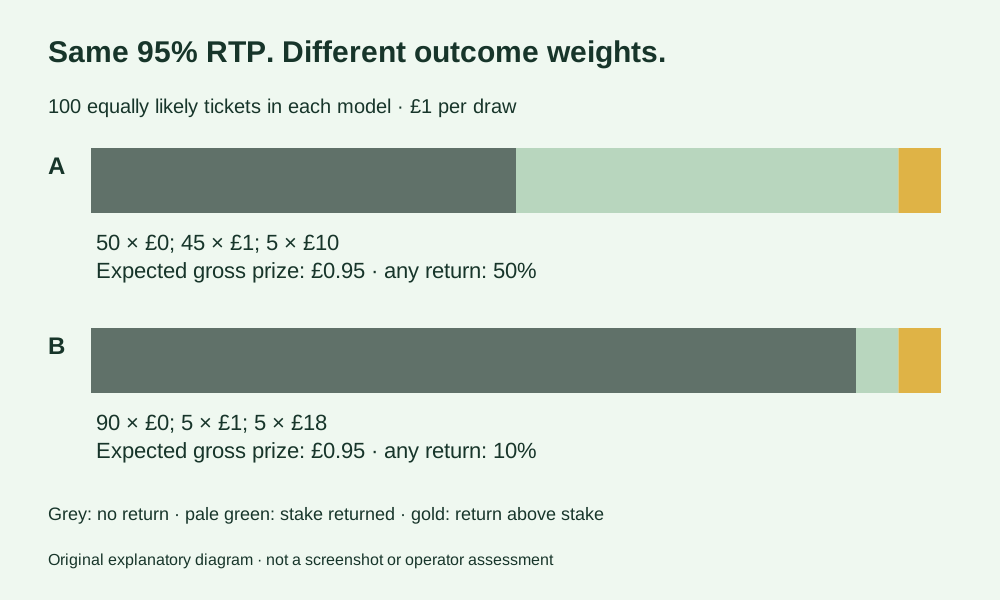
What does online slot RTP mean? Two games, one average
Two completely specified toy games both return 95% on average. Their outcome tables show why RTP, hit frequency and a session result answer different questions.
Read What does online slot RTP mean? Two games, one average
The paytable is part of the design
Clear rules explain the relationship between symbols, outcomes and changes of state.
Read The paytable is part of the design
Two RTP figures need a version check before a comparison
A version-aware RTP worksheet and a transparent 96% versus 94% example distinguish game specifications from session results without inventing casino data.
Read Two RTP figures need a version check before a comparison
How many spins is RTP based on?: what the maths sheet says and what a session shows
A slot's return to player is a designed figure taken from its paytable, not a count of spins. The Gambling Commission's own pages give the volumes it uses to check a live game against that figure, and a 10,000-session simulation shows how far a £20 session sits from it.
Read How many spins is RTP based on?: what the maths sheet says and what a session shows
A wild does not automatically count as a scatter
Separate substitution, scatter counting and feature triggers through two provider examples and an invented reel result that can be checked without playing.
Read A wild does not automatically count as a scatter
A 95% RTP describes millions of spins, not the one you're about to play
The Gambling Commission publishes the formula behind its own return-to-player checks. Run that formula for a session length people actually play, rather than the volumes the regulator monitors, and the number on the paytable stops looking precise.
Read A 95% RTP describes millions of spins, not the one you're about to play
Continue reading
What does online slot RTP mean? Two games, one average
Two completely specified toy games both return 95% on average. Their outcome tables show why RTP, hit frequency and a session result answer different questions.
Read What does online slot RTP mean? Two games, one averageHow many spins is RTP based on?: what the maths sheet says and what a session shows
A slot's return to player is a designed figure taken from its paytable, not a count of spins. The Gambling Commission's own pages give the volumes it uses to check a live game against that figure, and a 10,000-session simulation shows how far a £20 session sits from it.
Read How many spins is RTP based on?: what the maths sheet says and what a session showsTwo RTP figures need a version check before a comparison
A version-aware RTP worksheet and a transparent 96% versus 94% example distinguish game specifications from session results without inventing casino data.
Read Two RTP figures need a version check before a comparisonWhat does online slot RTP mean? Two games, one average
The paytable is part of the design
A 95% RTP describes millions of spins, not the one you're about to play
Two RTP figures need a version check before a comparison
How many spins is RTP based on?: what the maths sheet says and what a session shows