Facts checked Article
Mechanics
What does online slot RTP mean? Two games, one average
Two completely specified toy games both return 95% on average. Their outcome tables show why RTP, hit frequency and a session result answer different questions.
What 95% describes
Return to player is a ratio between expected prizes and stakes. In a simple game with a £1 stake and a 95% theoretical RTP, the expected gross prize is 95p per play. Gross matters: that prize figure is measured before subtracting the £1 paid to take part.
The expected net result is therefore a loss of 5p per play under the model's assumptions.
That statement does not predict a particular spin. It also does not mean a £20 deposit will become exactly £19. A deposit and total money staked are different quantities, especially if returned money is used again.
This workshop makes the distinction concrete with two invented games. They are mathematical examples with complete outcome tables, not available products, game recommendations or reconstructions of a commercial slot's hidden probability model.
The figures on this page
- 95% theoretical RTP
- In a simple game with a £1 stake and a 95% theoretical RTP, the expected gross prize is 95p per play. The expected net result is therefore a loss of 5p per play under the model’s assumptions.This page’s own outcome tables · as checked on
- Game A
- Fifty tickets return £0, 45 return £1, and five return £10. Every draw costs £1.This page’s own outcome tables · as checked on
- Game B
- Ninety tickets return £0, five return £1, and five return £18. The theoretical RTP is still 95%.This page’s own outcome tables · as checked on
- Hit frequency
- The probability of receiving any prize greater than zero: 50% for A and 10% for B. Profitable-result frequency, the probability of receiving more than the £1 stake, is 5% for both.This page’s own outcome tables · as checked on
- RTS 7
- The Gambling Commission’s RTS 7 requires acceptably random outcomes and prohibits adaptive, compensated behaviour within its stated scope.RTS 7: random outcomes · as checked on
- RTS 3
- The Commission’s RTS 3 sets requirements for understandable game rules and information about the likelihood of winning before commitment within its scope.RTS 3: rules and likelihood of winning · as checked on
Each fact restates a sentence from this page. The two games are invented for the arithmetic; the two standards are the Commission’s.
Game A: frequent small returns
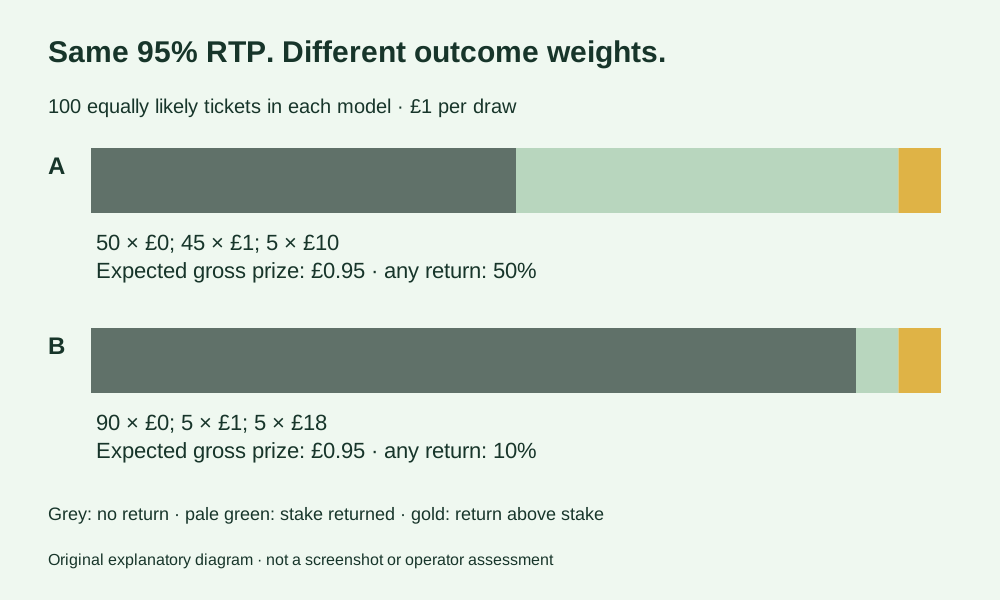
Imagine a random draw from 100 equally likely tickets, with the ticket replaced before the next draw. Fifty tickets return £0, 45 return £1, and five return £10. Every draw costs £1.
The possible outcomes and their probabilities are now completely specified; there is no undisclosed feature, progressive contribution or changing state.
Multiply each prize by its probability and add the results: 0.50 × £0 + 0.45 × £1 + 0.05 × £10 = £0.95. Dividing by the £1 stake gives 95% RTP. Half the tickets return something, but 45 out of 100 merely return the stake.
Calling all of those outcomes profitable wins would hide an important distinction. Under this particular table, only the £10 outcome produces a positive net result.
Terms used on this page
- Return to player (RTP)
- A ratio between expected prizes and stakes. It describes a game over many plays, not a particular spin or a deposit.
- Expected gross prize
- The prize figure measured before subtracting the stake paid to take part; 95p per £1 play at 95% RTP.
- Hit frequency
- For these toy games, the probability of receiving any prize greater than zero.
- Profitable-result frequency
- The probability of receiving more than the £1 stake; a return of the stake alone is not counted.
- Standard deviation
- A compact way to quantify the spread of outcomes: the dispersion of the gross prize around the mean for one £1 draw. It is not an operator’s volatility label.
Game B: fewer returns, a larger top outcome
Keep the £1 stake and 100-ticket model, but change the contents. Ninety tickets return £0, five return £1, and five return £18. Its expected gross prize is 0.90 × £0 + 0.05 × £1 + 0.05 × £18 = £0.95.
The theoretical RTP is still 95%.
Only ten tickets in every hundred return anything in Game B's probability model. The top outcome is larger, while the average remains unchanged. Our comparison therefore disproves a simple inference: two games with the same RTP do not have to distribute prizes in the same way.
The chart shows probability weights, not a recorded hundred-spin session. Sampling 100 independent draws does not force every ticket type to appear exactly in its stated proportion.
Name the quantity before comparing it
For these toy games, define hit frequency as the probability of receiving any prize greater than zero. That produces 50% for A and 10% for B. Define profitable-result frequency as the probability of receiving more than the £1 stake.
That produces 5% for both. These definitions are explicit so the figures can be checked; a commercial description may use different terminology.
The spread of outcomes also differs. A compact way to quantify it is the standard deviation of the gross prize for one £1 draw. The specified tables give approximately £2.13 for A and £3.92 for B.
This is a calculation from our tables, not an operator's volatility label. It describes dispersion around the mean, not the maximum possible loss, a safe stake or a recommended playing style.
Two invented games, one average
| Quantity | Game A | Game B | Evidence |
|---|---|---|---|
| Ticket contents (100 equally likely tickets, replaced before the next draw; every draw costs £1) | Fifty tickets return £0, 45 return £1, and five return £10. | Ninety tickets return £0, five return £1, and five return £18. | · This page’s own outcome tables |
| Expected gross prize | 0.50 × £0 + 0.45 × £1 + 0.05 × £10 = £0.95 | 0.90 × £0 + 0.05 × £1 + 0.05 × £18 = £0.95 | · This page’s own outcome tables |
| Theoretical RTP | 95% | 95% | · This page’s own outcome tables |
| Hit frequency (any prize greater than zero) | 50% | 10% | · This page’s own outcome tables |
| Profitable-result frequency (more than the £1 stake) | 5% | 5% | · This page’s own outcome tables |
| Standard deviation of the gross prize for one £1 draw | approximately £2.13 | approximately £3.92 | · This page’s own outcome tables |
The quantities are defined in the section above so the figures can be checked; a commercial description may use different terminology.
The average is not a settling-up promise
If the ticket is replaced and the model remains unchanged, a new draw uses the same probabilities after a loss as after a prize. There is no balancing mechanism that owes a particular participant money. A streak does not create an obligation for the next outcome to restore the advertised average.
That distinction also has a regulatory context. The Gambling Commission's RTS 7 requires acceptably random outcomes and prohibits adaptive, compensated behaviour within its stated scope. It addresses the implementation of regulated remote games; our ticket examples provide a separate transparent way to understand the arithmetic.
Neither the standard nor the example allows us to infer a commercial game's full probability table from its artwork or a short recording. The published rules and the actual game version remain important evidence.
Sources: RTS 7: random outcomes.
Use the calculator to check the model
The worksheet lets you choose A or B, a hypothetical stake and a fixed number of draws. It calculates total stakes, expected gross return and expected net result using the disclosed 95% ratio. Change the game and those expectations stay the same, while the hit frequency and single-draw spread change.
That is the comparison the exercise is designed to reveal.
At £1 for 100 predetermined draws, total stakes are £100, expected gross prizes are £95 and the expected net result is minus £5. These are model expectations across possible outcomes. They are not a likely-looking cash balance, a promise about an individual session or a calculation of what can be afforded.
The tool does not simulate play, accept money, contact a casino or save entries.
How to use the worksheet
The worksheet below this section calculates expectations, not a session forecast. It does not simulate play, accept money, contact a casino or save entries.
Choose Game A or Game B
The worksheet lets you choose A or B. Both are the invented games specified above, with complete outcome tables.
Enter a hypothetical stake
A hypothetical stake per draw. Nothing is staked; the figure only feeds the arithmetic.
Fix the number of draws in advance
The worksheet fixes the number of draws in advance and displays total stakes explicitly. It does not model stopping when funds run out, changing stakes, deposits, withdrawals or bonus conditions.
Read the three outputs
It calculates total stakes, expected gross return and expected net result using the disclosed 95% ratio.
Change the game and compare
Change the game and those expectations stay the same, while the hit frequency and single-draw spread change. That is the comparison the exercise is designed to reveal.
What the result means
At £1 for 100 predetermined draws, total stakes are £100, expected gross prizes are £95 and the expected net result is minus £5. These are model expectations across possible outcomes. They are not a likely-looking cash balance, a promise about an individual session or a calculation of what can be afforded.
Why a deposit is not the denominator
Suppose a hypothetical account starts with £10. A person could stake some of that money, receive a return, and stake some returned money again. Total stakes would then count each amount committed, not just the original deposit.
A claim that 95% RTP means losing only 5% of the deposit confuses these two accounting measures.
Our worksheet avoids that confusion by fixing the number of draws in advance and displaying total stakes explicitly. It does not model stopping when funds run out, changing stakes, deposits, withdrawals or bonus conditions. Those processes can change the distribution of a final balance and the amount ultimately staked.
They cannot be reconstructed accurately by treating a deposit as though it were a single wager. Keep the denominator attached to the number whenever discussing return.
What the worksheet does not model
Those processes can change the distribution of a final balance and the amount ultimately staked. They cannot be reconstructed accurately by treating a deposit as though it were a single wager.
Ticks are kept only in this browser and are never sent anywhere.
This calculates mathematical expectations, not a session forecast. No spins, deposits or gambling take place.
Take three questions back to the rules
When reading a real online slot description, ask which game version the information belongs to, which mode or feature it covers, and what the percentage actually describes. The Commission's RTS 3 sets requirements for understandable game rules and information about the likelihood of winning before commitment within its scope.
RTP is one form that likelihood information can take; the standard does not turn it into an individual outcome guarantee.
Then separate what is known from what is absent. A percentage alone does not supply a complete prize distribution, the chance of a particular feature, or a forecast for tonight.
The useful result of this workshop is an improved reading habit: identify the average, inspect the outcome structure where it is disclosed, and keep hypothetical mathematics clearly apart from evidence about a named commercial game.
Sources: RTS 3: rules and likelihood of winning.
Three questions to take back to the rules
Ask them of a real online slot description before reading its percentage as a promise.
Ticks are kept only in this browser and are never sent anywhere.
Questions answered
Does 95% RTP mean I get £95 back from a £100 deposit?
No. RTP describes expected prizes relative to total stakes under the stated model, not a guaranteed return on a deposit or a particular session.
Can two slots have the same RTP and different hit frequencies?
Yes. Our completely specified toy games both have 95% RTP, while their probabilities of any return are 50% and 10%. This illustrates the arithmetic; the games are not commercial products.
Does a losing streak make a win due?
Not in the independent, unchanged ticket models used here. Replacing the ticket after each draw preserves the same probabilities. The model has no mechanism that owes a particular participant a balancing prize.
What is hit frequency, and why does it differ when RTP is the same?
For these toy games, hit frequency is the probability of receiving any prize greater than zero: 50% for A and 10% for B. Profitable-result frequency, the probability of receiving more than the £1 stake, is 5% for both. Two games with the same RTP do not have to distribute prizes in the same way.
Why is a deposit not the denominator for RTP?
Total stakes count each amount committed, not just the original deposit, because returned money can be staked again. A claim that 95% RTP means losing only 5% of the deposit confuses these two accounting measures.
Game documentation
Continue reading
Near misses: what the standard says and what a session shows
The gap between symbols on a screen is not a measure of how close the next result is. RTS 7C bans near misses that are built rather than drawn.
Read Near misses: what the standard says and what a session shows
The paytable is part of the design
Clear rules explain the relationship between symbols, outcomes and changes of state.
Read The paytable is part of the design
Two RTP figures need a version check before a comparison
A version-aware RTP worksheet and a transparent 96% versus 94% example distinguish game specifications from session results without inventing casino data.
Read Two RTP figures need a version check before a comparison
How many spins is RTP based on?: what the maths sheet says and what a session shows
A slot's return to player is a designed figure taken from its paytable, not a count of spins. The Gambling Commission's own pages give the volumes it uses to check a live game against that figure, and a 10,000-session simulation shows how far a £20 session sits from it.
Read How many spins is RTP based on?: what the maths sheet says and what a session shows
A wild does not automatically count as a scatter
Separate substitution, scatter counting and feature triggers through two provider examples and an invented reel result that can be checked without playing.
Read A wild does not automatically count as a scatter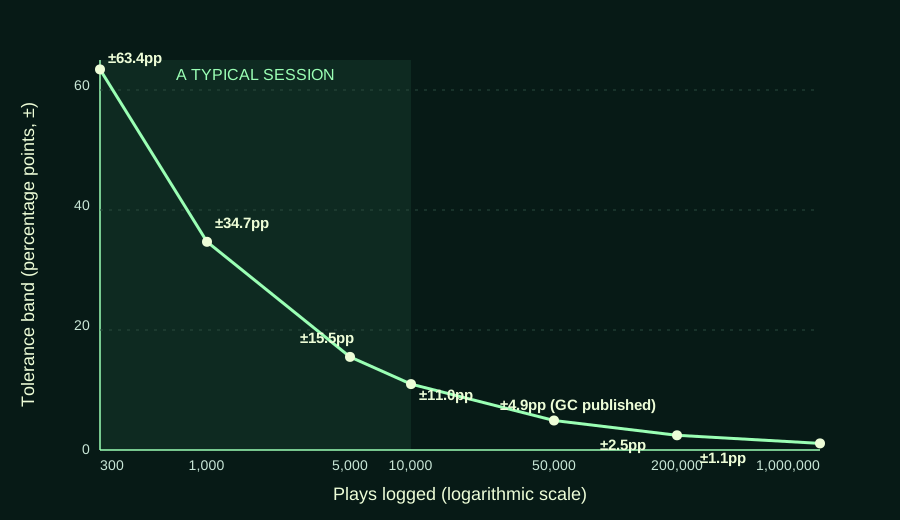
A 95% RTP describes millions of spins, not the one you're about to play
The Gambling Commission publishes the formula behind its own return-to-player checks. Run that formula for a session length people actually play, rather than the volumes the regulator monitors, and the number on the paytable stops looking precise.
Read A 95% RTP describes millions of spins, not the one you're about to play
Continue reading
Near misses: what the standard says and what a session shows
The gap between symbols on a screen is not a measure of how close the next result is. RTS 7C bans near misses that are built rather than drawn.
Read Near misses: what the standard says and what a session showsHow many spins is RTP based on?: what the maths sheet says and what a session shows
A slot's return to player is a designed figure taken from its paytable, not a count of spins. The Gambling Commission's own pages give the volumes it uses to check a live game against that figure, and a 10,000-session simulation shows how far a £20 session sits from it.
Read How many spins is RTP based on?: what the maths sheet says and what a session showsTwo RTP figures need a version check before a comparison
A version-aware RTP worksheet and a transparent 96% versus 94% example distinguish game specifications from session results without inventing casino data.
Read Two RTP figures need a version check before a comparisonNear misses: what the standard says and what a session shows
The paytable is part of the design
A 95% RTP describes millions of spins, not the one you're about to play
Two RTP figures need a version check before a comparison
How many spins is RTP based on?: what the maths sheet says and what a session shows