Facts checked Article
Reading games
A wild does not automatically count as a scatter
Separate substitution, scatter counting and feature triggers through two provider examples and an invented reel result that can be checked without playing.
The symbol’s job comes from the rule
A wild symbol may substitute for other symbols when a slot evaluates a paying combination. That does not establish that it also counts towards a scatter trigger. The exception is not theoretical: Play’n GO’s description of Firefly Frenzy says its Firefly Wilds substitute for symbols except the Scatter.
The same page describes a separate interaction between a Firefly and the Moon Scatter which can activate a feature.
Substitution and triggering are therefore different questions. If a reader sees two scatter symbols and a wild, the answer is not automatically “three scatters”. First read what the wild may replace, then read what the feature requires.
A symbol can participate in more than one rule without making those rules interchangeable.
This article compares published provider descriptions and an original paper example. It does not test a game client, name an available UK casino, rank slots or calculate a strategy. The task is to read exceptions accurately.
A provider’s public description can establish how it describes a mechanic; only the rules for the exact game and version in front of a player can settle every detail of that implementation.
Sources: Firefly Frenzy.
The sheet says: two providers, one standard
- Firefly Frenzy: substitution
- Play’n GO’s description says its Firefly Wilds substitute for symbols except the Scatter.Firefly Frenzy · as checked on
- Firefly Frenzy: activation
- The same page describes a separate interaction between a Firefly and the Moon Scatter which can activate a feature.Firefly Frenzy · as checked on
- Combined symbols
- Play’n GO’s general scatter explanation notes that some games combine wild and scatter functions in one symbol.What does Scatter mean in slots? · as checked on
- Win-A-Beest: state changes the award
- Three scatters in the base game are described as awarding eight Stampeding Spins; three scatters during Beest Mode are described as awarding four Beest Mode Spins.Win-A-Beest · as checked on
- RTS 3
- The Gambling Commission’s RTS 3 requires applicable rules to be easily available before a customer commits to gambling.RTS 3 – Rules, game descriptions and the likelihood of winning · as checked on
Published provider descriptions and the Commission's standard. None of this establishes how a particular casino client behaves or what the next spin does.
Keep substitution, payment and activation separate
Play’n GO’s general explanation of scatters describes their use in activating features and awarding results outside an ordinary winning payline. It also notes that some games combine wild and scatter functions in one symbol. The useful lesson is variation: “wild” and “scatter” describe jobs in a ruleset, not two universal pieces of software.
Build a reading card with three questions. Substitution: which symbols may this symbol stand in for, and which are excluded? Payment: is an award evaluated on a line, across positions, or by another specified arrangement?
Activation: what exact event starts the feature, including the required number of symbols and the current game state?
Do not fill one answer from another. A picture that pays in scattered positions might also trigger a feature, but the trigger may require a different count. A wild might help form a line while being excluded from the feature count.
A combined symbol might perform both jobs because its own rules say so.
This three-question card is the article’s method. It is deliberately narrower than a complete paytable review. It does not infer a symbol’s probability, RTP contribution or frequency from its artwork, its name or the amount of space devoted to it in promotional copy.
Sources: What does Scatter mean in slots?.
How to fill the three-question reading card
The article's method, in order. It is narrower than a complete paytable review and infers nothing about probability or RTP from artwork.
Substitution: what may it replace
Which symbols may this symbol stand in for, and which are excluded? Read the exclusion before anything else.
Payment: how is the award evaluated
Is an award evaluated on a line, across positions, or by another specified arrangement?
Activation: what starts the feature
What exact event starts the feature, including the required number of symbols and the current game state?
What the result means
Three separate answers, none filled from another. A wild might help form a line while being excluded from the feature count; a combined symbol performs both jobs only because its own rules say so.
Firefly Frenzy shows why a separate interaction matters
The provider describes Firefly Frenzy’s feature as involving a Firefly landing on the Moon Scatter. Its description also connects the triggering Firefly’s multiplier to the multipliers available during the feature. Those are additional conditions beyond the substitution exclusion already noted.
Read the two statements side by side. “Does not substitute for the Scatter” answers whether a wild can be treated as that symbol in the substitution rule. “A Firefly lands on the Moon Scatter” describes an interaction involving both symbols.
There is no contradiction in excluding a symbol from substitution while giving it a different role in activation.
For a paper annotation, draw two boxes: one labelled substitution and the other labelled interaction. Put the exception in the first and the triggering relationship in the second. That is enough to expose a common reading error without reproducing the game’s artwork or making a demonstration spin.
We have not verified the feature’s probability, regional availability or the exact help panel in a live casino. The provider page is used as a concrete example of rule structure. Its promotional descriptions are not adopted as recommendations, and its themed imagery is not reproduced in the original figure.
Sources: Firefly Frenzy.
Win-A-Beest makes game state part of the trigger
Play’n GO’s Win-A-Beest page distinguishes a standard wild from a multiplier wild, which multiplies the wins it forms by two. It also gives different scatter awards for different states. Three scatters in the base game are described as awarding eight Stampeding Spins.
Three scatters during Beest Mode are described as awarding four Beest Mode Spins.
Those numbers belong to different named features. They are not competing accounts of one universal “three-scatter payout”. A record that copies only the symbol count loses the condition that makes each statement meaningful.
Here is the comparison in compact form: base game, three scatters, eight Stampeding Spins; Beest Mode, three scatters, four Beest Mode Spins. The provider also describes awards for larger counts, but the three-symbol comparison is sufficient for our purpose. It demonstrates why the state column belongs beside the count column.
There is no basis here for deciding that eight is better than four. The features have different rules, and their value cannot be inferred from spin counts alone. This is a comparison of disclosed triggers, not a return calculation or a recommendation to seek a particular game state.
No claim about the chance of reaching either feature is made.
| Provider example | State | Count | Described award |
|---|---|---|---|
| Win-A-Beest | Base game | 3 scatters | 8 Stampeding Spins |
| Win-A-Beest | Beest Mode | 3 scatters | 4 Beest Mode Spins |
Sources: Win-A-Beest.
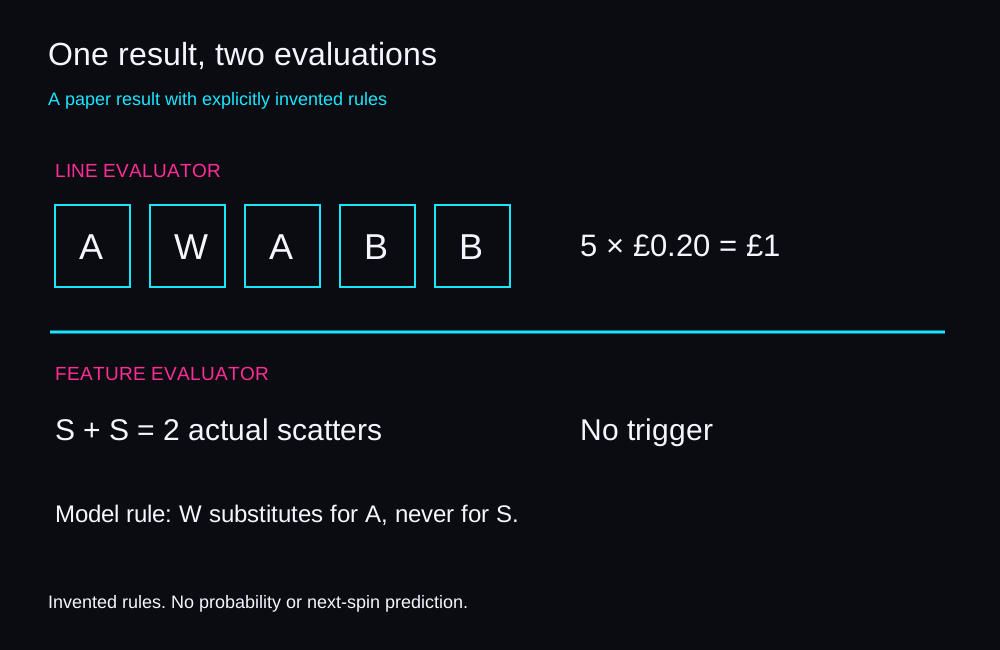
An invented reel result that pays on a line but triggers nothing
Take a fictional five-reel slot, created only for this explanation. Its rules say that three A symbols on an active line pay five times the line stake. W substitutes for A, but not for S.
A feature requires three actual S symbols anywhere in the five-reel result. Assume the line stake is 20p and that no other payment or trigger applies.
On the active line the symbols are A–W–A–B–B. Elsewhere in the same result there are two S symbols. The line evaluator treats W as A, so the three-symbol line award is five multiplied by 20p, which equals £1.
The trigger evaluator counts two actual S symbols. It therefore does not activate the feature. The wild has done its line job without becoming a third scatter.
The comparison has three rows. A–W–A on the line: substitution permitted, £1 line award. Two actual S symbols elsewhere: trigger count equals two, feature absent.
The combined result: a paying line and no feature. Every quantity in this example is invented and labelled, and the arithmetic concerns an award rather than net profit across a session.
Now change only the fictional exclusion so that W counts towards the feature as well. That would be a different ruleset, and its outcome would require reevaluation. The screen image alone would not tell us that the rule had changed.
This is why a remembered result from another slot is not a substitute for reading the present explanation.
Paper result: the three rows
Every quantity is invented and labelled. The arithmetic concerns a line award, not net profit across a session, and no probability is attached.
Ticks are kept only in this browser and are never sent anywhere.
The information needs to describe the current state
The Gambling Commission’s RTS 3 requires applicable rules to be easily available before a customer commits to gambling. Its guidance includes rules about collecting tokens to qualify for features and the behaviour of those features. It separately addresses information needed to understand the current game state, including relevant feature labels and collected tokens.
That provides a documentary basis for asking a precise question when a description is unclear. Instead of “Why did the wild not work?”, ask which substitution exclusion applied, which state the game was in and which activation condition was unmet. These questions identify the missing explanation without assuming a software fault.
The distinction also helps when taking notes from a provider page. Put each statement beside the feature it names. If the description refers to a free-spins state but a screenshot depicts the base game, do not combine them into one supposed observation.
A marketing page may describe several states in a few sentences; a useful editorial comparison expands their conditions rather than compressing them further.
This article’s provider examples are documentary, not a compliance audit. We did not inspect a casino’s placement of its help link or verify the behaviour of its deployed software. Those remain different pieces of evidence.
Sources: RTS 3 – Rules, game descriptions and the likelihood of winning.
Paytable words used on this page
- Wild
- A symbol that may stand in for other symbols when a line is evaluated, subject to the exclusions its own rules list.
- Scatter
- A symbol whose award or trigger is counted by position rather than on a payline, as the game's rules define it.
- Game state
- Which mode the game is in, such as the base game or a named feature; the same count can award different things in each.
- Paytable
- The game's own list of symbols, awards and conditions; the place its substitution and trigger rules are written.
- RTP
- Return to player: the share of stakes a game is designed to return over a very long run. It cannot be read from a symbol's artwork.
- RTS
- The Gambling Commission's remote gambling and software technical standards; RTS 3 covers rules and RTS 7 random outcomes.
A failed trigger does not make the next trigger due
The Commission’s remote random-outcomes standard requires acceptably random results and prohibits adaptive compensated behaviour within its scope. It also addresses misleading presentation, including substituting a different losing outcome to manufacture a near miss. Those requirements do not turn a visually promising arrangement into a forecast.
Our paper result contains two scatters because we specified two scatters. It contains no probability model. Nothing in the example allows us to calculate the next spin’s trigger chance, a waiting time or a recovery plan.
Adding the £1 line award likewise supplies no information about the next result.
A final reading card can therefore end with four entries: the exact symbol rule, the feature condition, the current state and the unresolved information. For the invented game, the unresolved information includes every outcome probability. For the provider examples, it includes the exact casino client and version, which were not inspected.
The practical gain is understanding a result without attaching a prediction to it. A wild can complete one condition and leave another unsatisfied. A scatter count can lead to different features in different states.
The rules explain those distinctions; neither the illustration nor a previous near miss supplies the missing probabilities.
Sources: RTS 7 – Generation of random outcomes.
The final reading card: four entries
A displayed count or a previous near miss supplies none of the missing probabilities.
Ticks are kept only in this browser and are never sent anywhere.
Questions answered
What is a scatter symbol and how does it work?
Its function depends on the slot’s rules. The provider material used here describes scatter awards and feature triggers, while also showing that the relevant count and game state can vary.
Can a wild replace a scatter?
Only when the particular rules permit that function. Firefly Frenzy’s provider description expressly excludes its Scatter from ordinary wild substitution.
Do three scatters always award the same number of free spins?
No universal number follows from the label. Win-A-Beest’s provider page describes different named features and awards for three scatters in the base game and Beest Mode.
Can one symbol be both wild and scatter?
Yes, the provider’s general scatter explanation describes combined functions. That possibility does not allow a reader to assume every wild has both roles.
Does missing a scatter trigger make the next spin more likely to trigger?
This article supplies no such prediction. A displayed count or near miss is not evidence that a future feature is due, and the paper example does not specify probabilities.
What does RTS 3 require about feature rules?
The Gambling Commission’s RTS 3 requires applicable rules to be easily available before a customer commits to gambling, including rules about collecting tokens to qualify for features and information about the current game state.
What should I ask when a wild did not trigger a feature?
Ask which substitution exclusion applied, which state the game was in and which activation condition was unmet. Those questions identify the missing explanation without assuming a software fault.
Game documentation
Continue reading
The paytable is part of the design
Clear rules explain the relationship between symbols, outcomes and changes of state.
Read The paytable is part of the design
Two RTP figures need a version check before a comparison
A version-aware RTP worksheet and a transparent 96% versus 94% example distinguish game specifications from session results without inventing casino data.
Read Two RTP figures need a version check before a comparison
What does online slot RTP mean? Two games, one average
Two completely specified toy games both return 95% on average. Their outcome tables show why RTP, hit frequency and a session result answer different questions.
Read What does online slot RTP mean? Two games, one average
Near misses: what the standard says and what a session shows
The gap between symbols on a screen is not a measure of how close the next result is. RTS 7C bans near misses that are built rather than drawn.
Read Near misses: what the standard says and what a session shows
How many spins is RTP based on?: what the maths sheet says and what a session shows
A slot's return to player is a designed figure taken from its paytable, not a count of spins. The Gambling Commission's own pages give the volumes it uses to check a live game against that figure, and a 10,000-session simulation shows how far a £20 session sits from it.
Read How many spins is RTP based on?: what the maths sheet says and what a session shows
A 95% RTP describes millions of spins, not the one you're about to play
The Gambling Commission publishes the formula behind its own return-to-player checks. Run that formula for a session length people actually play, rather than the volumes the regulator monitors, and the number on the paytable stops looking precise.
Read A 95% RTP describes millions of spins, not the one you're about to play
Continue reading
Two RTP figures need a version check before a comparison
A version-aware RTP worksheet and a transparent 96% versus 94% example distinguish game specifications from session results without inventing casino data.
Read Two RTP figures need a version check before a comparisonThe paytable is part of the design
Clear rules explain the relationship between symbols, outcomes and changes of state.
Read The paytable is part of the designHow many spins is RTP based on?: what the maths sheet says and what a session shows
A slot's return to player is a designed figure taken from its paytable, not a count of spins. The Gambling Commission's own pages give the volumes it uses to check a live game against that figure, and a 10,000-session simulation shows how far a £20 session sits from it.
Read How many spins is RTP based on?: what the maths sheet says and what a session showsWhat does online slot RTP mean? Two games, one average
Near misses: what the standard says and what a session shows
The paytable is part of the design
A 95% RTP describes millions of spins, not the one you're about to play
Two RTP figures need a version check before a comparison
How many spins is RTP based on?: what the maths sheet says and what a session shows