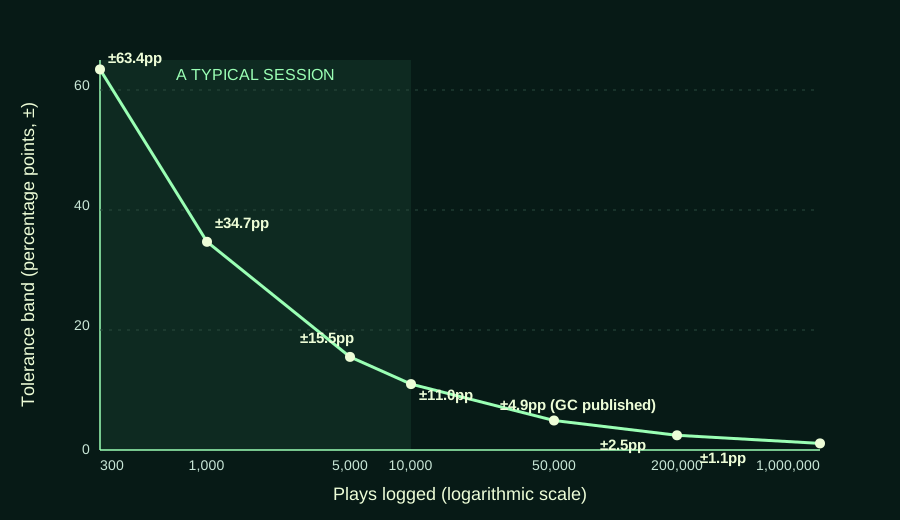
The Gambling Commission publishes the formula behind its own return-to-player checks. Run that formula for a session length people actually play, rather than the volumes the regulator monitors, and the number on the paytable stops looking precise.
A slot's return to player is a designed figure taken from its paytable, not a count of spins. The Gambling Commission's own pages give the volumes it uses to check a live game against that figure, and a 10,000-session simulation shows how far a £20 session sits from it.
Separate substitution, scatter counting and feature triggers through two provider examples and an invented reel result that can be checked without playing.
A version-aware RTP worksheet and a transparent 96% versus 94% example distinguish game specifications from session results without inventing casino data.
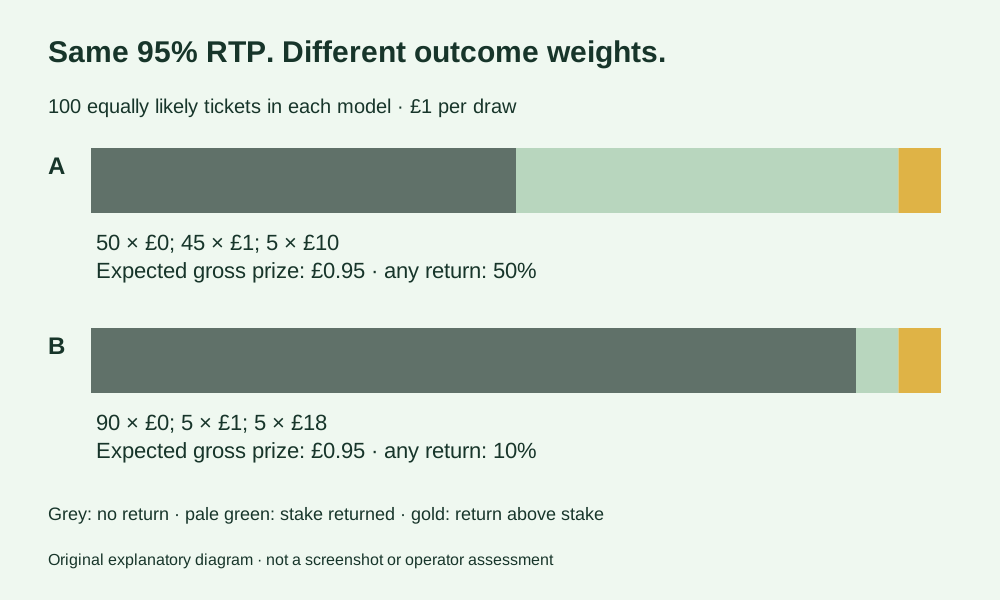
Two completely specified toy games both return 95% on average. Their outcome tables show why RTP, hit frequency and a session result answer different questions.
How can I check the RTP rates on online casino websites?
Open the game's rules or help panel before staking; under RTS 3C a GB-licensed operator must make the RTP percentage, house edge or probability information easily available before you commit to gamble. The Commission's key-terms page says the theoretical RTP is the advertised figure displayed in the player-facing rules, so the panel is the place to read it.
How to locate game RTP percentages on casino websites?
Look in the game's 'help' or 'how to play' pages, the artwork inside the game, or the links on the game selection pages. The RTS 3C implementation guidance names those as the acceptable places, and says the figure should be the average theoretical return to player percentage.
Which online casinos offer transparent RTP information for slot games?
Every operator on the Gambling Commission's register must meet RTS 3C, so the information is a licence requirement rather than a feature of any one site. This page names no operator; the test is whether the figure is reachable before you stake.
There is no fixed threshold; the Gambling Commission states there is "no minimum RTP on a gaming machine." A percentage is more informative alongside its volatility figure, since two games sharing an RTP can behave very differently across a session.
It means that, as an average across a very large number of plays, the game is designed to return 95% of stakes as prizes. The Commission's own guidance states RTP "is an average achieved over a significant number of game plays and not each time the gaming machine is played."