Facts checked Article
Numbers
How many spins is RTP based on?: what the maths sheet says and what a session shows
A slot's return to player is a designed figure taken from its paytable, not a count of spins. The Gambling Commission's own pages give the volumes it uses to check a live game against that figure, and a 10,000-session simulation shows how far a £20 session sits from it.
How many spins is RTP based on?
How many spins is RTP based on? The short answer is none. RTP is not based on a number of spins. It is a designed figure, worked out from the paytable before the game is released, and the Gambling Commission's key-terms page defines the theoretical RTP as 'the designed return to player percentage of the game'.
The spins come afterwards, when a regulator or an operator measures whether the live game is behaving as designed.
The Commission does publish the volumes it uses for that measuring. Its public page on gaming machines, read 21 September 2026, states that 'Average %RTP is generally measured over 10,000 or 100,000 games for compensated machines and more games than this for random machines, depending on their category'.
For online games the same regulator's live-monitoring guide gives no fixed number at all. It says that 'after a significant amount of plays the actual RTP should be very close or equal to the theoretical RTP'. It adds that the tolerance 'will be wider when only a limited amount of play has been measured'.
So the fuller answer has two parts. The sheet figure rests on the paytable's probabilities, which need no spins. The check that a live game matches its sheet needs tens of thousands of games at the least, and for a swingy game far more.
A session of 100 spins at £0.20 is not in that territory, and this page shows how far outside it sits.
Sources checked 21 September 2026.
Sources: Key terms relating to live return to player performance monitoring of games of chance; Return to player: how much gaming machines payout; Live return to player performance monitoring of games of chance.
What the Commission's pages say about the number of games, read 21 September 2026
- Theoretical RTP
- 'The designed return to player percentage of the game'; it is also the advertised figure shown in the player-facing rules under RTS 3CKey terms relating to live return to player performance monitoring of games of chance · as checked on
- Actual RTP
- 'Calculated using the generated win and turnover figures of the live (operational) game' for the period measuredKey terms relating to live return to player performance monitoring of games of chance · as checked on
- Gaming machines
- Average %RTP 'generally measured over 10,000 or 100,000 games for compensated machines and more games than this for random machines'Return to player: how much gaming machines payout · as checked on
- Remote games
- No fixed count: the tolerance 'will be wider when only a limited amount of play has been measured, but as the volume of play increases the tolerance will decrease'Live return to player performance monitoring of games of chance · as checked on
- Confidence used
- The deviation from the mean in the Commission's method 'is calculated with a 95% confidence interval'Live return to player performance monitoring of games of chance · as checked on
- Compensated play
- 'Adaptive behaviour (that is, a compensated game) is not permitted' for remote games under RTS 7ARTS 7 – Generation of random outcomes · as checked on
The sheet figure — what it is, what it costs
The sheet says a percentage. RTS requirement 3C, read 21 September 2026, requires that information enabling 'an informed decision about his or her chances of winning' is easily available before a customer commits to gamble. It lists 'the return to player (RTP) percentage' as one of the acceptable forms.
The implementation guidance names it more precisely as 'the average theoretical return to player percentage'.
That word 'theoretical' is the whole answer to the spins question. The figure is calculated from the probability and size of every prize on the paytable. A paytable with a 1% chance of a 50-times prize contributes half a stake to the RTP whether the game has been played once or a billion times.
Nothing about it changes with volume.
What changes with volume is how close a real run of play lands to it. RTS 7A requires outcomes to be 'acceptably random' and forbids compensated games, so a slot cannot steer itself back towards its sheet figure after a losing hour. Each spin is one draw from the same distribution.
The sheet figure is where the draws average out; it is not where any particular evening ends.
A £20 session at 96% has an expected cost of £0.80 in the long run. The word 'expected' is doing heavy lifting: the worked example below shows that half of such sessions cost more than that and a tenth cost more than £7.
Sources: RTS 3 – Rules, game descriptions and the likelihood of winning; RTS 7 – Generation of random outcomes.
400,000 games — what the Commission's own worked example shows
The Commission's guide on calculating RTP, read 21 September 2026, carries one worked example. A game with £1,200,000 of turnover and £1,085,000 in wins gives 1,085,000 / 1,200,000 = .9042, an actual RTP of 90.42%. The same game 'was designed with a 91.68% RTP' and has a 'volatility (standard deviation) of 5.6'.
After '400,000 games had been played', the guide states, the 'allowable tolerance will be 1.75 above or below 91.68', so the game 'could return between 89.93% and 93.43%'.
Read that slowly. Four hundred thousand games is roughly 4,000 sessions of 100 spins, and the regulator's own method still allows nearly two percentage points either side of the sheet. The example game sits 1.26 points under its sheet and passes.
That is what 'based on' means in practice: a band, not a point, and a band that only tightens as the count grows.
The live-monitoring guide adds why the band is wider for some games than others. 'A highly volatile game will have a larger tolerance and might be comprised of prizes falling into the "very large but rare" category.' The standard deviation, it explains, 'depends on the game's cycle and prize frequency'.
Two games with the same 96% can need very different volumes before their actual figures settle.
Sources: How to calculate return to player (RTP); Key terms relating to live return to player performance monitoring of games of chance; Live return to player performance monitoring of games of chance.
The table: simulator
The table sets out the volumes the Commission's pages actually name, each row with its page and the date it was read. Below it, the calculator turns the Commission's 95% method into a number of spins for any standard deviation, and the sessions after that are simulated rather than measured.
The simulation uses two synthetic paytables, both designed to exactly 96.00% RTP, built for this page so that every prize and probability can be printed. The steadier one pays something on 33.1% of spins and its largest prize is 50 times the stake. The swingier one pays on 17.45% of spins and its largest prize is 2,000 times the stake.
Each was run for 10,000 sessions at £0.20 a spin with a fixed seed; the script and its full output are in the evidence folder named in the sources, and anyone with Node can re-run them. Neither paytable is a real game.
A session shows this. Over 100 spins on the steadier paytable, the middle session returned 92.0% and the middle 80% of sessions fell between 64.0% and 134.0%. Over 2,000 spins the same band had narrowed to 88.3%–104.0%.
On the swingier paytable the 100-spin median was 56.0% and the band was 29.0%–129.0%, and even at 2,000 spins the median sat at 86.3%. Only 1.5% of 100-spin sessions on the steadier game landed within one point of 96%; on the swingier game it was 0.6%.
The calculator's figure for the steadier paytable is 296,894 spins: that is how many it takes before the 95% band is one point wide. At £0.20 a spin that is £59,378.80 of turnover. For the swingier paytable the same band needs about 12.7 million spins.
Those are counts and costs, not returns.
Sources: Return to player: how much gaming machines payout; How to calculate return to player (RTP); Live return to player performance monitoring of games of chance; What volume of play should be achieved before measuring the actual RTP?.
| Setting | Volume named | What it is for | Source page | Evidence |
|---|---|---|---|---|
| Gaming machines, compensated | 10,000 or 100,000 games | The count over which average %RTP is 'generally measured' | Return to player: how much gaming machines payout | · Return to player: how much gaming machines payout |
| Gaming machines, random | 'more games than this', by category | Random machines need a larger count than compensated ones | Return to player: how much gaming machines payout | · Return to player: how much gaming machines payout |
| Commission worked example, remote game | 400,000 games | Tolerance of ±1.75 points around a 91.68% design at standard deviation 5.6 | How to calculate return to player (RTP) | · How to calculate return to player (RTP) |
| Live monitoring, rolling window | Previous 30 days, or 90 days in parallel | Daily measurements on fresh data; a wider window for greater volume | What volume of play should be achieved before measuring the actual RTP? | · What volume of play should be achieved before measuring the actual RTP? |
| Live monitoring, by count | 'once X number of plays has been achieved' | The guide leaves X to the licensee; no minimum is stated | What volume of play should be achieved before measuring the actual RTP? | · What volume of play should be achieved before measuring the actual RTP? |
| Confidence level | 95% interval | The deviation from the mean is calculated at this level | Live return to player performance monitoring of games of chance | · Live return to player performance monitoring of games of chance |
Spins before the 95% band is one point wide
Enter a game's standard deviation per spin (in stakes) and a stake. The output is the number of spins at which the Commission's 95% method leaves a band of ±1 percentage point around the sheet figure, and what that many spins costs in turnover. It shows cost and count only.
Worked example: with standard deviation per spin 2.78 stakes, stake per spin £0.20, spins for a ±1 point band is 296,894 spins and turnover to reach that count is £59,378.80. Steadier synthetic paytable, standard deviation 2.78, £0.20 a spin.
Formula and figures: Live return to player performance monitoring of games of chance
Method: spins = (1.96 × standard deviation ÷ 0.01)². The 1.96 is the 95% confidence figure the Commission's guide uses; the standard deviation is the game's own, as defined on the key-terms page. The example uses the steadier synthetic paytable from this page (standard deviation 2.78).
A worked example in pounds
Take £20, staked as 100 spins at £0.20 on the steadier 96% paytable. The sheet says £19.20 back on average, a cost of £0.80. A session shows something else.
Across 10,000 simulated sessions the tenth-percentile session got £12.80 back, the median got £18.40, and the ninetieth percentile got £26.80. More than half of the sessions, 55.8%, finished below the sheet figure.
The same £20 on the swingier 96% paytable, again 100 spins at £0.20, is a different evening. The tenth percentile got £5.80 back, the median £11.20, and the ninetieth £25.80. Just over three sessions in four, 78.1%, finished below 96%.
The rare 500-times and 2,000-times prizes carry a fifth of that paytable's return between them, and almost no 100-spin session meets one. Their share of the RTP is real, and it is paid to somebody else's session.
Stretch the same stake to 2,000 spins, £400 of turnover at £0.20, and the steadier paytable's middle 80% of sessions now sit between £353.00 and £416.00 back. The swingier one still spans £238.20 to £643.60. The count that settles one game leaves the other wide open.
A losing run is the normal shape of a session, not a signal. If sessions are running longer or costing more than you planned, a deposit limit and GamCare (0808 8020 133) are the two nearest tools.
Sources: Key terms relating to live return to player performance monitoring of games of chance; Live return to player performance monitoring of games of chance.
What this page does not tell you
It does not name a game. The two paytables are synthetic, built so that every figure in them can be checked; no provider's sheet was read for this entry, and no published RTP is quoted for any title. The Commission's example game is anonymous on the Commission's page and stays anonymous here.
It does not tell you what figure applies at a particular operator. RTS 3C requires the figure to be available before you commit, and the key-terms page says the theoretical RTP 'will also be the advertised RTP of the game as displayed in the player facing rules'.
Whether one operator's panel shows a different figure from another's for the same title is not established by any page read for this entry, so it is not claimed.
It does not tell you what a near miss means; the sibling entry on randomness and near misses does. It does not tell you what RTP describes when the question is the size of the average rather than the count behind it. The entry on RTP and your session covers that, and this page is the count-and-band companion to it.
General probability sits with Odds & Ends.
Sources: RTS 3 – Rules, game descriptions and the likelihood of winning; Key terms relating to live return to player performance monitoring of games of chance.
Questions answered
Three stored questions from the same search cluster, each answered in a sentence first.
Sources: RTS 3 – Rules, game descriptions and the likelihood of winning; Key terms relating to live return to player performance monitoring of games of chance; Live return to player performance monitoring of games of chance.
Questions answered
How can I check the RTP rates on online casino websites?
Open the game's rules or help panel before staking; under RTS 3C a GB-licensed operator must make the RTP percentage, house edge or probability information easily available before you commit to gamble. The Commission's key-terms page says the theoretical RTP is the advertised figure displayed in the player-facing rules, so the panel is the place to read it, and the date you read it is worth noting.
Source: RTS 3 – Rules, game descriptions and the likelihood of winning
How to locate game RTP percentages on casino websites?
Look in the game's 'help' or 'how to play' pages, the artwork inside the game, or the links on the game selection pages. The RTS 3C implementation guidance names those as the acceptable places. The guidance also says the figure should be 'the average theoretical return to player percentage', so expect one percentage, not a range of session outcomes.
Source: RTS 3 – Rules, game descriptions and the likelihood of winning
Which online casinos offer transparent RTP information for slot games?
Every operator on the Gambling Commission's register must meet RTS 3C, so the information is a licence requirement rather than a feature of any one site. This page names no operator; the test is whether the figure is reachable before you stake, and you can apply it to any lobby yourself.
Source: RTS 3 – Rules, game descriptions and the likelihood of winning
Sources checked 21 September 2026
Every page below was read over HTTPS on 21 September 2026. The simulation script and its full output are saved beside this draft as research-updates/launch-content/reel-and-story/evidence/034d-rtp-convergence-simulation.cjs and .json. The figures in the table above come from the Commission's pages, and the session figures in the prose come from that script.
Sources: Key terms relating to live return to player performance monitoring of games of chance; Return to player: how much gaming machines payout; Live return to player performance monitoring of games of chance; What volume of play should be achieved before measuring the actual RTP?; How to calculate return to player (RTP); Other considerations for live return to player performance monitoring of games of chance; RTS 3 – Rules, game descriptions and the likelihood of winning; RTS 7 – Generation of random outcomes.
Source ledger
Every page read over HTTPS on 21 September 2026; re-check due within 30 days of publication.
| Source | Publisher | Read on | Re-check due | Note |
|---|---|---|---|---|
| Key terms relating to live return to player performance monitoring of games of chance | Gambling Commission | On the next revisit | ||
| Return to player: how much gaming machines payout | Gambling Commission | On the next revisit | ||
| Live return to player performance monitoring of games of chance | Gambling Commission | On the next revisit | ||
| What volume of play should be achieved before measuring the actual RTP? | Gambling Commission | On the next revisit | ||
| How to calculate return to player (RTP) | Gambling Commission | On the next revisit | ||
| Other considerations for live return to player performance monitoring of games of chance | Gambling Commission | On the next revisit | ||
| RTS 3 – Rules, game descriptions and the likelihood of winning | Gambling Commission | On the next revisit | ||
| RTS 7 – Generation of random outcomes | Gambling Commission | On the next revisit |
Questions answered
How can I check the RTP rates on online casino websites?
Open the game's rules or help panel before staking; under RTS 3C a GB-licensed operator must make the RTP percentage, house edge or probability information easily available before you commit to gamble. The Commission's key-terms page says the theoretical RTP is the advertised figure displayed in the player-facing rules, so the panel is the place to read it.
How to locate game RTP percentages on casino websites?
Look in the game's 'help' or 'how to play' pages, the artwork inside the game, or the links on the game selection pages. The RTS 3C implementation guidance names those as the acceptable places, and says the figure should be the average theoretical return to player percentage.
Which online casinos offer transparent RTP information for slot games?
Every operator on the Gambling Commission's register must meet RTS 3C, so the information is a licence requirement rather than a feature of any one site. This page names no operator; the test is whether the figure is reachable before you stake.
Game documentation
- Key terms relating to live return to player performance monitoring of games of chance
- Return to player: how much gaming machines payout
- Live return to player performance monitoring of games of chance
- What volume of play should be achieved before measuring the actual RTP?
- How to calculate return to player (RTP)
- Other considerations for live return to player performance monitoring of games of chance
- RTS 3 – Rules, game descriptions and the likelihood of winning
- RTS 7 – Generation of random outcomes
Continue reading
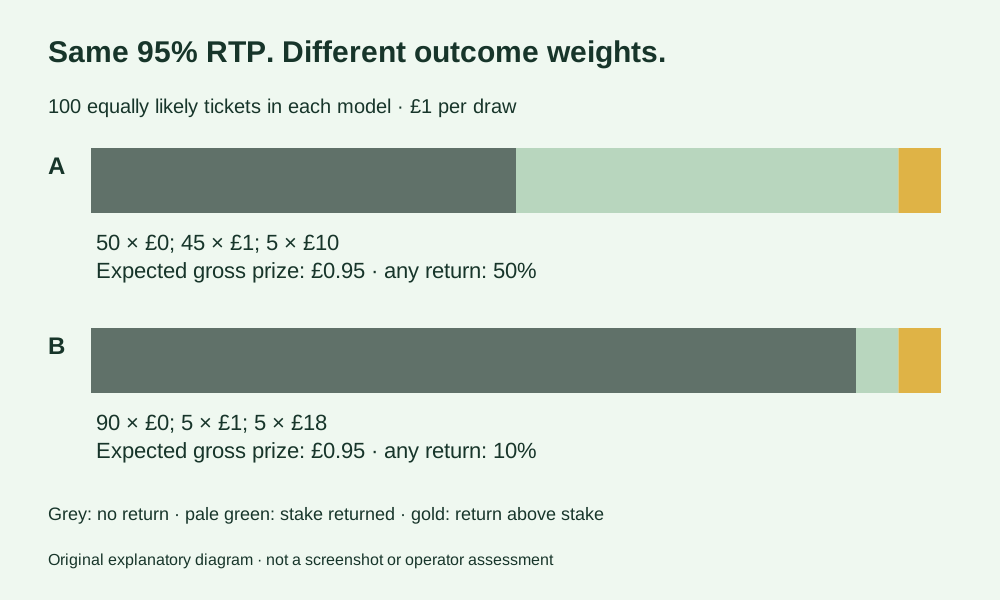
What does online slot RTP mean? Two games, one average
Two completely specified toy games both return 95% on average. Their outcome tables show why RTP, hit frequency and a session result answer different questions.
Read What does online slot RTP mean? Two games, one average
Near misses: what the standard says and what a session shows
The gap between symbols on a screen is not a measure of how close the next result is. RTS 7C bans near misses that are built rather than drawn.
Read Near misses: what the standard says and what a session shows
The paytable is part of the design
Clear rules explain the relationship between symbols, outcomes and changes of state.
Read The paytable is part of the design
Two RTP figures need a version check before a comparison
A version-aware RTP worksheet and a transparent 96% versus 94% example distinguish game specifications from session results without inventing casino data.
Read Two RTP figures need a version check before a comparison
A wild does not automatically count as a scatter
Separate substitution, scatter counting and feature triggers through two provider examples and an invented reel result that can be checked without playing.
Read A wild does not automatically count as a scatter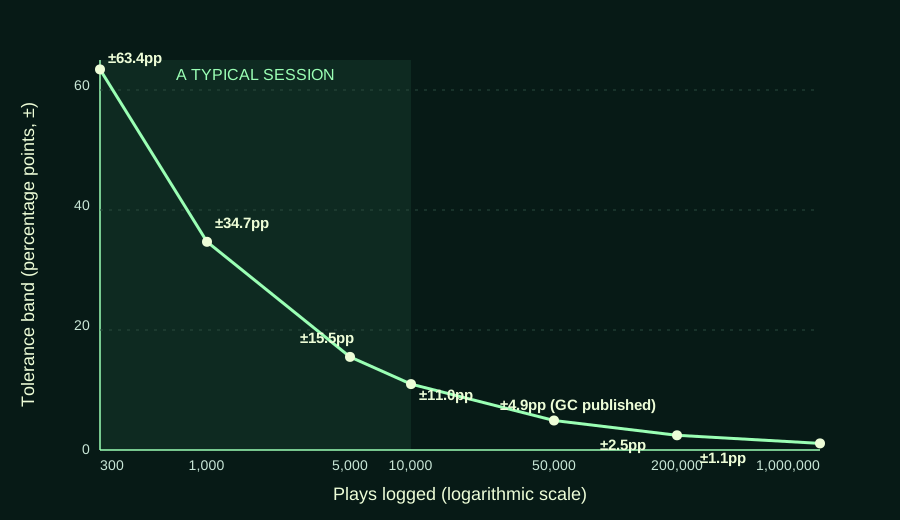
A 95% RTP describes millions of spins, not the one you're about to play
The Gambling Commission publishes the formula behind its own return-to-player checks. Run that formula for a session length people actually play, rather than the volumes the regulator monitors, and the number on the paytable stops looking precise.
Read A 95% RTP describes millions of spins, not the one you're about to play
Continue reading
Two RTP figures need a version check before a comparison
A version-aware RTP worksheet and a transparent 96% versus 94% example distinguish game specifications from session results without inventing casino data.
Read Two RTP figures need a version check before a comparisonA wild does not automatically count as a scatter
Separate substitution, scatter counting and feature triggers through two provider examples and an invented reel result that can be checked without playing.
Read A wild does not automatically count as a scatterWhat does online slot RTP mean? Two games, one average
Two completely specified toy games both return 95% on average. Their outcome tables show why RTP, hit frequency and a session result answer different questions.
Read What does online slot RTP mean? Two games, one averageWhat does online slot RTP mean? Two games, one average
Near misses: what the standard says and what a session shows
The paytable is part of the design
A 95% RTP describes millions of spins, not the one you're about to play